
Why Rowers Don’t Need Too Much Weight Training
When people think about developing strength, weight training is often the first method that comes to mind. But for rowers, the equation is a bit different. While strength is undeniably essential in rowing, rowers actually spend surprisingly little time lifting weights. On average, only one in every fifteen training sessions takes place in the weight room. Much of the sport-specific strength can be built on the water or on the erg.
Strength training doesn’t only happen in the gym — it’s built right into your rowing sessions. When you row on the erg or on the water, adjusting your stroke rate (SPM) changes the load on your muscles. At lower stroke rates (around 18–22 SPM), each drive becomes longer and heavier. This increases the drag factor on the erg and the resistance in the water, forcing you to push harder with your legs and connect more powerfully through your core. It’s like slow lifting for rowers — building strength and control through steady, powerful strokes. These low-rate workouts are a hidden gem in rowing training. They not only build muscular endurance and power but also improve technique, because you have more time to feel the connection between the catch, drive, and finish.
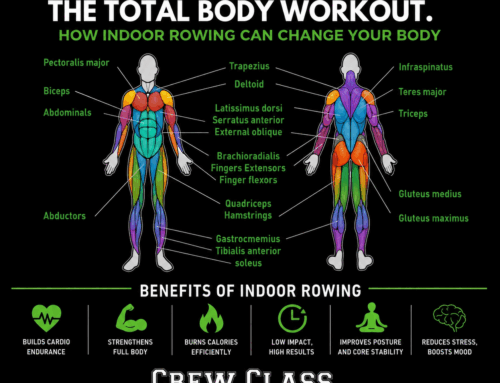
Why is that? Because rowing itself builds strength. The rowing stroke is a full-body movement that combines power, endurance, and coordination. Every stroke recruits major muscle groups — legs, glutes, core, back, and arms. When rowers spend hours each week repeating that motion—often against high resistance—they’re effectively strength training, just in a more sport-specific way.
Research shows that elite rowers produce between 300 to 500 watts per stroke during high-intensity pieces. That’s equivalent to performing an explosive leg press or deadlift every few seconds for extended periods. Unlike traditional gym work, rowing builds muscular endurance and explosive strength simultaneously, targeting the exact demands of racing.
That’s not to say strength training isn’t valuable. It plays an important role in preventing injuries, improving balance, and building muscle. But rowing isn’t a substitute for proper weight training — it won’t turn you into Arnold Schwarzenegger, and that’s fine. With so many hours already devoted to rowing and cardio, there’s little room — or real need — for heavy lifting to dominate.
In short, the boat (or erg) is the rower’s weight room. Strength comes not from maxing out on squats, but from thousands of powerful, technical strokes. For rowers, smart strength training is about complementing the sport — not replacing it.